Robert Harris's Agrippa: A Gripping Portrait of Ancient Rome's Rivalries
Robert Harris's latest novel, Agrippa, delves into the world of ancient Rome, focusing on the life of Agrippa, Octavius's right-hand man. Harris's narrative weaves a complex tale of power struggles, betrayals, and shifting alliances, offering a nuanced portrayal of a Rome exhausted by civil strife.
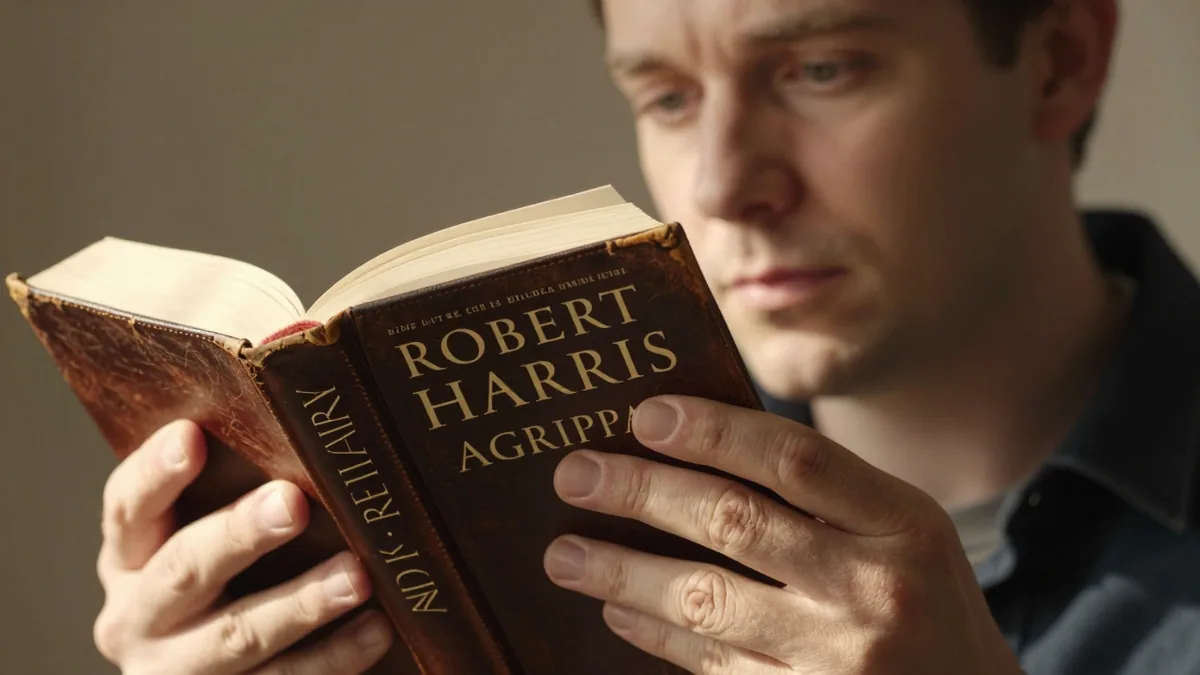
A new novel by Robert Harris, Agrippa, offers a fresh perspective on ancient Rome. Harris's latest work follows his previous trilogy of novels about the life of Cicero and his one-off about the unpleasantness in Pompeii. This time, he takes readers on a journey from civil war through the assassination of Julius Caesar, the battle of Actium, and Octavius's rise to power as Caesar Augustus.
The novel is narrated from the point of view of Agrippa, Octavius's right-hand man, a figure who is less well-remembered than his counterpart. Harris notes that Agrippa left behind few speeches, letters, and direct quotations, yet he was an effective co-ruler of the Roman world for many years and the greatest general of the period.
Harris's portrayal of Octavius is multifaceted, depicting him as vain, clever, sickly, ambitious, manipulative, and prickly. In contrast, Agrippa is established as a bit of a meathead, who is more interested in duffing up people than in politics. Their friendship is forged when Agrippa helps Octavius with his classwork and teaches him how to fight.
The novel's framing conceit is that the text is Agrippa's memoir, written in haste and high feeling. Agrippa, now an old man of 50, has come home early from an expedition to duff up the barbarians in Illyricum. He has a gammy leg, which is about to kill him.
He limps in to find his wife in bed with his son-in-law, who is also the emperor's adopted son. Instead of getting busy with his sword, Agrippa retreats to his chamber and turns to words.
Harris's discipline as a novelist is evident in Agrippa's narrative, which is told in almost comically unambitious prose. Agrippa is a bastard for an aqueduct, loves them, and is never happier than when building infrastructure and explaining the engineering principles and logistics to the reader.
When Agrippa is stirred to reflection, he tends to reach for a well-worn phrase. From this elegantly drab stuff emerges a more subtle portrait of the man and the age than you might expect. The novel offers a persuasive portrait of a Rome exhausted by civil strife, and of the serpentine manoeuvrings of its rulers.
Everyone is betraying everyone else, raising armies, marrying each other's children, forming and breaking alliances. It's hectic. And, gosh, all these people redrawing the map of the world and changing the course of history are young. The plot twist concerns the real parentage of the apparently low-born Agrippa, a feature of scholarly speculation since 1937.
Harris's afterword reveals that Agrippa's most enduring real-world monument is seven terse words in stone above the entrance to the Pantheon: M F AGRIPPA L F COS TERTIUM FECIT. "Marcus Agrippa, son of Lucius, in his third consulship, did it."
A Gripping Portrait of Ancient Rome's Rivalries
Harris's novel offers a nuanced portrayal of a Rome exhausted by civil strife. The novel's complex tale of power struggles, betrayals, and shifting alliances is woven together with Harris's characteristic skill. The result is a gripping portrait of ancient Rome's rivalries that is both engaging and informative.
A Subtle Portrait of the Man and the Age
The novel's framing conceit, Agrippa's memoir, is a clever device that allows Harris to explore the complexities of Agrippa's character. Agrippa's narrative is told in almost comically unambitious prose, which belies the subtlety of the portrait that emerges. The novel offers a more subtle portrait of the man and the age than you might expect, one that is both engaging and thought-provoking.
A Fresh Perspective on Ancient Rome
Harris's novel offers a fresh perspective on ancient Rome, one that is both engaging and informative. The novel's complex tale of power struggles, betrayals, and shifting alliances is woven together with Harris's characteristic skill. The result is a gripping portrait of ancient Rome's rivalries that is both engaging and informative.
Source: The Guardian Books