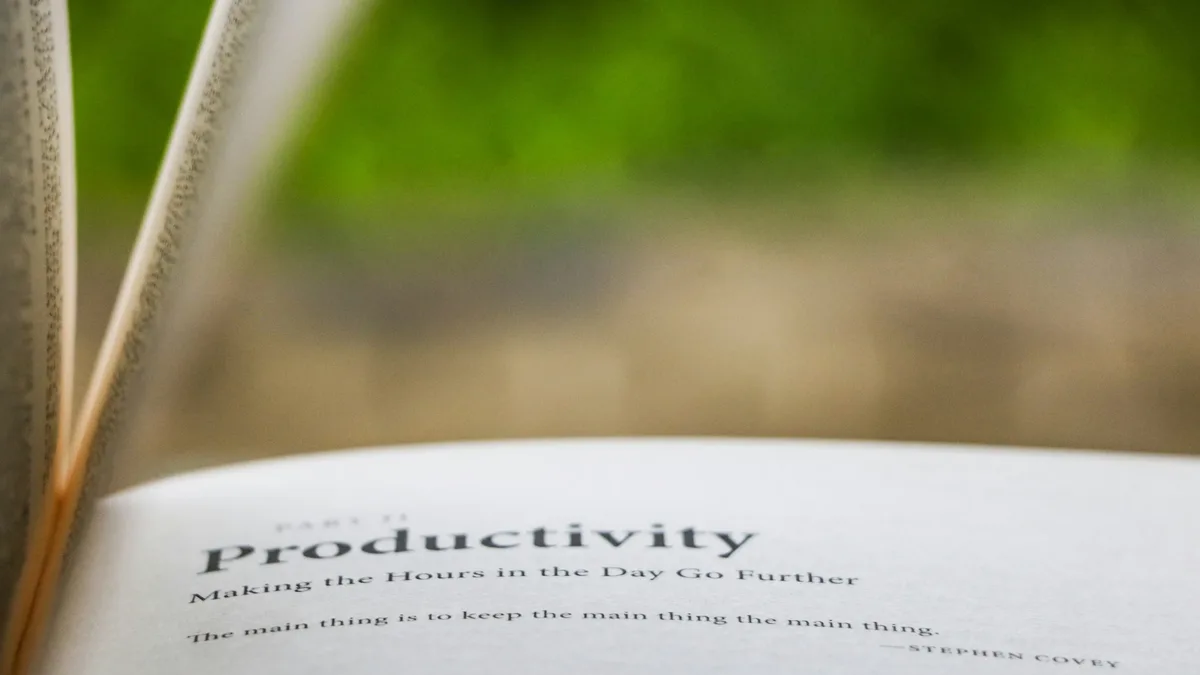
Best Productivity Books
| First documented | 20th century |
|---|---|
| Original use | Improve work or life efficiency |
| Genre | Non-fiction, self-help |
| Typical structure | Systems, frameworks, or principles |
| Common medium | Print book, audiobook |
| Focus areas | Time management, task organization, habit formation |
| Key author types | Business leaders, psychologists, consultants |
| Associated philosophy | Often incorporates Stoicism, Minimalism, or behavioral science |
Origin and history
The genre of productivity books, as a distinct category of non-fiction aimed at improving personal efficiency and work management, originated primarily in the United States in the early 20th century. Its foundations are often traced to the industrial efficiency studies of Frederick Winslow Taylor and later to the broader self-help movement. The mid-century saw the publication of foundational texts that moved from pure industrial management to individual office and personal productivity. The late 20th and early 21st centuries, particularly with the rise of information work and digital tools, catalyzed an explosion in the genre. This period transformed productivity advice from corporate manual material into a mass-market publishing phenomenon. The genre continues to evolve, heavily influenced by technology, neuroscience, and changing workplace cultures.
What it is for
Productivity books are designed to provide systems, principles, and psychological insights to help individuals accomplish more meaningful work in less time and with less stress. They aim to improve the reader's ability to manage tasks, projects, time, attention, and energy across personal and professional domains. A core function is to offer structured methodologies for prioritizing work, overcoming procrastination, and establishing effective habits. These books often address the cognitive challenges of the modern work environment, such as information overload and constant digital distraction. Beyond mere efficiency, many texts in the genre argue for a holistic approach that connects productivity to broader life goals and personal fulfillment. They serve as both practical manuals and sources of motivational philosophy for readers seeking greater control over their output and their time.
Best Best Productivity Books books
This section lists seminal and widely recognized titles that have defined the productivity genre. "Getting Things Done: The Art of Stress-Free Productivity" by David Allen, published by Viking in 2001, introduced the GTD methodology. "The 7 Habits of Highly Effective People" by Stephen R. Covey, published by Simon & Schuster in 1989, frames productivity around principle-centered leadership. "Deep Work: Rules for Focused Success in a Distracted World" by Cal Newport, published by Grand Central Publishing in 2016, argues for concentrated cognitive effort. "Atomic Habits: An Easy & Proven Way to Build Good Habits & Break Bad Ones" by James Clear, published by Avery in 2018, focuses on incremental systems change. "The Power of Habit: Why We Do What We Do in Life and Business" by Charles Duhigg, published by Random House in 2012, explores the science of habit formation. "Essentialism: The Disciplined Pursuit of Less" by Greg McKeown, published by Crown Business in 2014, advocates for a systematic approach to identifying what is absolutely crucial.
Best books for Best Productivity Books
This section recommends key texts for understanding the genre's evolution and critical perspectives. "The Efficiency Expert: The Life and Career of Frank Bunker Gilbreth" by Jane C. Lancaster provides historical context on early efficiency movements. "The Tyranny of the Moment: Fast and Slow Time in the Information Age" by Thomas Hylland Eriksen critiques the cultural pressures that make productivity feel necessary. "The Burnout Society" by Byung-Chul Han, originally published in German as "Müdigkeitsgesellschaft" in 2010 and translated by Erik Butler, analyzes the pathological side of achievement culture. "Rest: Why You Get More Done When You Work Less" by Alex Soojung-Kim Pang, published by Basic Books in 2016, challenges core assumptions of the genre. "The Productivity Project: Accomplishing More by Managing Your Time, Attention, and Energy" by Chris Bailey, published by Crown Business in 2016, is a useful survey of contemporary techniques. "Four Thousand Weeks: Time Management for Mortals" by Oliver Burkeman, published by Farrar, Straus and Giroux in 2021, offers a philosophical counterpoint to the genre's obsession with optimization.
Overview
The productivity book genre encompasses a wide spectrum of approaches, from rigid tactical systems to broad philosophical guides. Common themes include task management, habit formation, focus cultivation, goal setting, and the strategic use of technology. The underlying premise of most works is that productivity is a skill that can be learned and improved through the application of specific frameworks. These books often synthesize research from psychology, neuroscience, business management, and behavioral economics into actionable advice for a general audience. A significant sub-genre focuses on combating the specific challenges of the digital age, such as email overload and social media distraction. The genre's tone ranges from cheerfully pragmatic to sternly admonishing, reflecting different authorial philosophies about human nature and discipline.
What to know
Readers should understand that productivity systems are highly personal, and no single book's advice will work universally for every individual or professional context. The implementation of any system requires an initial investment of time and energy to set up, often creating a short-term decrease in productivity before benefits are realized. Many popular methodologies are culturally specific, reflecting Western, and particularly American, values of individualism, output measurement, and professional achievement. Critically, productivity advice can sometimes conflate busyness with meaningful accomplishment, emphasizing volume of tasks over value of outcomes. The genre has been criticized for potentially fostering guilt and anxiety when readers fail to adhere perfectly to prescribed systems. It is advisable to read these books adaptively, extracting useful principles rather than following dogmatic rules.
Common questions
A common question is whether purchasing and reading multiple productivity books is counterproductive, as it can lead to system hopping without mastering any single approach. Readers often ask how to choose a system that fits their specific work style, whether they are a creative freelancer or a corporate manager. Many wonder about the necessity of using digital tools versus analog paper-based methods like bullet journaling for implementing the advice. A frequent inquiry concerns the evidence base for the claims made, as some books rely heavily on anecdotal experience rather than peer-reviewed research. People question how to maintain motivation for a productivity system after the initial enthusiasm has faded. There is also significant debate about the balance between rigid structure and necessary flexibility to handle unexpected events and creative work.
Pros and cons
A primary pro is that these books provide structured frameworks that can reduce decision fatigue and bring order to chaotic workloads, genuinely helping many people achieve more with less stress. They offer valuable insights into human psychology and behavior change that extend beyond mere work tasks into personal habit formation. A significant con is that they can promote an unhealthy obsession with optimization, leading to guilt and self-criticism when inevitable human limitations cause deviations from the system. The common mistake is to adopt a complex, all-encompassing methodology wholesale without customizing it, which often results in abandonment and a sense of failure. Many readers regret choosing books focused on industrial efficiency for knowledge work, finding the advice dehumanizing or ill-suited for creative, nonlinear tasks. The genre can also inadvertently prioritize individual performance over collaborative health and systemic workplace issues.
Who it suits
Productivity books best suit individuals who feel consistently overwhelmed by their commitments and are seeking a clear external structure to impose on their work and personal tasks. They are particularly useful for knowledge workers, students, and managers who must process large amounts of information and juggle multiple projects. People who are naturally systematic, detail-oriented, and motivated by a sense of control and completion often find these methodologies rewarding and effective. The genre also suits those undergoing a significant life or career transition, where old habits are no longer serving them and a new system can provide a stabilizing framework. Conversely, they may suit individuals who are highly skeptical but intellectually curious about the cultural phenomenon of productivity and wish to understand its principles critically. They are generally less suited for people whose work is inherently reactive, unstructured, or driven by spontaneous collaboration, or for those already prone to excessive self-criticism and perfectionism.
Latest Best Productivity Books news
Latest reporting

Alix E. Harrow wins 2026 Best Novel Hugo
Alix E. Harrow's 'The Everlasting' won Best Novel at the 2026 Hugo Awards, announced at the World Science Fiction Convention in Los Angeles.
Fall 2026 Indie Press Children's Books
Independent publishers are releasing six notable children's and YA titles in Fall 2026, exploring themes of home and family.

Fayard's Mille et Une Nuits Launches French
Fayard's Mille et Une Nuits imprint is launching a new collection of short, affordable books compiling famous quotes from four major French historical

New Children's Books Roundup
New children's picture books and novels are out, priced from £7.95 to £22. Authors include Allan Sanders, Kate Wakeling, and Frances Hardinge.

Regional Bookseller Organizations Emphasize Authors and Books
Regional bookseller organizations highlight authors and books at various conferences and events.

Alice Roberts: The Books that Shaped Her Humanist Perspective
The British author and academic shares her earliest reading memories and the books that influenced her humanist views.